Trading The Odds Behind Rocket Pharma's Pending FDA Decision
The FDA decision on KRESLADI is March 28. I built a probability-weighted options trading model of it.

There’s a gene therapy company trading at $4.19 a share that might be sitting on a $200 million lottery ticket by Friday.
Rocket Pharmaceuticals RCKT 0.00%↑ has its PDUFA date on March 28 for KRESLADI, a one-time gene therapy for severe leukocyte adhesion deficiency type 1. LAD-1, for short, is an ultra-rare pediatric immune disorder that’s basically a death sentence without a bone marrow transplant.
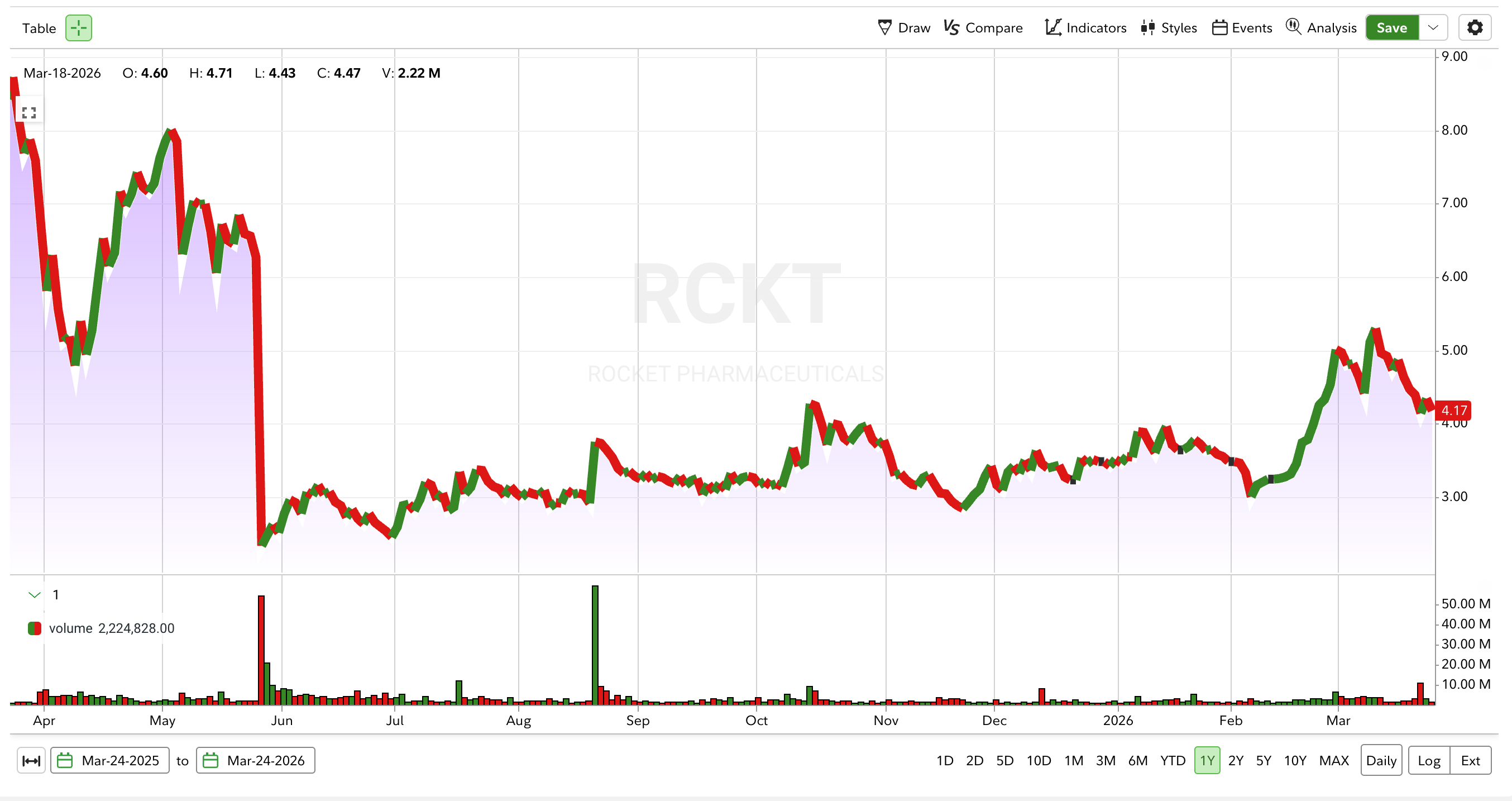
The stock is down about 67% over the past year. Market cap is around $470 million. And the expected value math, once you actually work through it, is kind of wild.
I built a probability-weighted model for an options trade of six scenarios with three for approval and three for a CRL.
The asymmetry and expected value (EV) is pretty striking.
Let me walk through it.
What is KRESLADI
LAD-I is caused by a mutation in the ITGB2 gene that leaves kids unable to fight infections. Without a transplant, most don’t survive childhood. KRESLADI takes a patient’s own stem cells, modifies them with a lentiviral vector to deliver a working copy of the gene, and gives them back.
The clinical data is about as clean as you’ll ever see in a phase 1/2 trial: 100% overall survival across all nine patients, all primary and secondary endpoints met, no treatment-related serious adverse events.
The FDA has never questioned the efficacy or safety profile.
So why hasn’t this been approved already?
Rocket’s Manufacturing Fumble
This is KRESLADI’s third time at the FDA’s door. The first BLA was accepted with priority review in late 2023. The FDA then extended the review period in early 2024 asking for more chemistry, manufacturing, and controls (CMC) information.
Then in June 2024 they were again issued a complete response letter, purely about CMC, not about whether the drug works or is safe.
Rocket says the FDA characterized the additional information needed as “limited.”
They resubmitted in October 2025 and got a new PDUFA date of March 28, 2026.
CRLs citing efficacy or safety concerns often require new clinical trials and years of additional work.
CMC issues, by contrast, are procedural in nature. They are fixable if the company has the manufacturing expertise.
The question is whether Rocket actually fixed it this time.
The PRV is the real pot of gold.
Here’s where it gets interesting.
If KRESLADI is approved, Rocket receives a Rare Pediatric Disease Priority Review Voucher. These vouchers let any pharma company cut its FDA review time from 10 months to 6 months on a future drug submission.
They’re transferable meaning Rocket can sell it to the highest bidder.
And the going rate for PRVs has been skyrocketing:
Zevra Therapeutics: $150M (February 2025)
Abeona Therapeutics: $155M (May 2025)
Bavarian Nordic: $160M (June 2025)
Jazz Pharmaceuticals: $200M (January 2026)
Fortress/Cyprium: $205M (February 2026)
That’s a 37% price increase in twelve months.
The reason is simple: the rare pediatric disease PRV program was sunset in late 2024 and the FDA can’t award any new ones after September 2026.
Supply is drying up, but demand isn’t.
So let’s think about what a $200M+ PRV means for a company with a $450M market cap and $189M in cash.
The voucher alone would represent roughly 45% of the entire company’s market value.
It would more than double their cash position overnight. And that’s before a single dose of KRESLADI is sold to a single patient.
Running the numbers behind the trade
I built a probability-weighted model for six scenarios with three for approval and three for a CRL.
The asymmetry and expected value (EV) is pretty striking.
